
The European Golden Visa landscape has changed dramatically in recent years. Spain shut its program entirely in April 2025. Portugal removed real estate as a qualifying route in 2023. Greece overhauled its pricing tiers. Malta lost its citizenship-by-investment program at the European Court of Justice. For investors who mapped out a route to EU citizenship several years ago, much of that planning is now outdated.
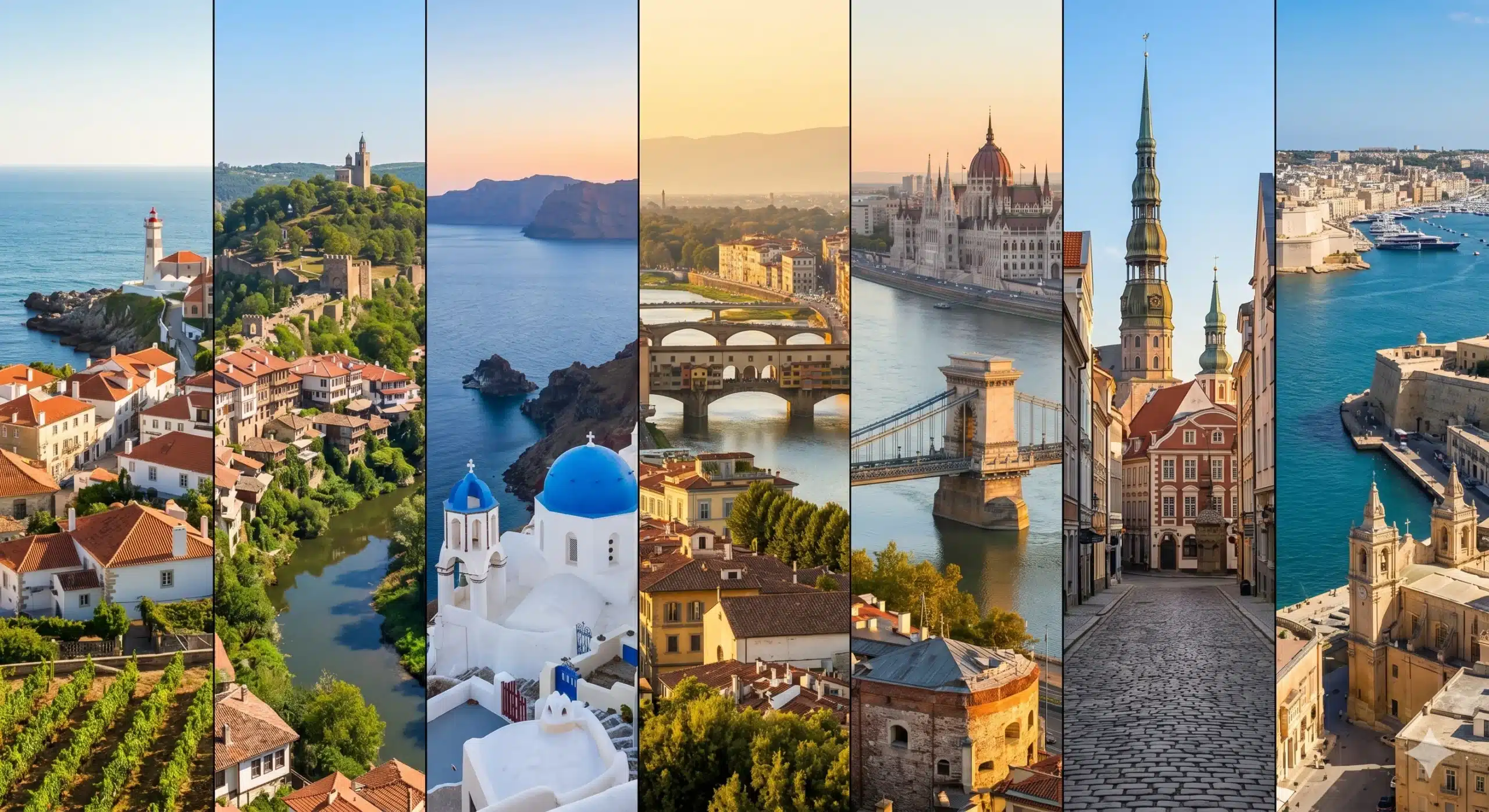
Yet the opportunity remains. As of May 2026, seven EU member states still operate active Golden Visa programs: Portugal, Bulgaria, Greece, Italy, Hungary, Malta, and Latvia. Each takes a different approach to the path from investment to residency to citizenship — and the differences are significant enough to determine whether EU citizenship is a realistic goal within your planning horizon, or a theoretical endpoint that never quite arrives.
This article examines each program specifically through the lens of citizenship: how long it takes, what physical presence it requires, what language and integration tests you will face, and what the practical obstacles are.
The Fundamental Distinction: Residency vs. Citizenship
Before comparing programs, it is worth being precise about what Golden Visas actually offer. A Golden Visa grants residency by investment — not citizenship. Citizenship, in every EU country, is governed by a separate body of nationality law and typically requires a defined period of lawful residence, a language exam, clean criminal record, financial sufficiency, and sometimes a history and integration test.
For more than a decade, Europe’s Golden Visa programs have offered wealthy non-EU nationals a relatively straightforward route to residency—and eventually citizenship—in some of the world’s most stable democracies. But by 2026, the landscape has changed dramatically.
Several countries, including Spain, Ireland, and the Netherlands, have shut down their investor residency schemes, while the European Union has increased scrutiny over programs perceived as “selling” access to Europe. At the same time, the European Court of Justice dealt a major blow to Malta’s citizenship-by-investment framework, ruling that EU citizenship cannot be treated as a commercial transaction.
Despite this tightening environment, a handful of EU countries still maintain Golden Visa programs. Yet the real distinction between them is no longer simply investment thresholds—it is the pathway to citizenship itself.
The New Reality of EU Golden Visas
Today’s European Golden Visa market is defined by three major trends:
- Longer timelines to citizenship
- Higher physical presence requirements
- Greater emphasis on integration
While all remaining programs provide residency rights and Schengen mobility, the route to an EU passport varies enormously from country to country.
Portugal: From Europe’s Fastest Track to a Longer Road
For years, Portugal was considered the gold standard of European residency-by-investment.
The appeal was simple:
- Minimal stay requirement (roughly 7 days per year)
- A clear route to citizenship
- Flexible investment structures
- Basic language knowledge
- Access to an EU passport without relocating full-time
Under the traditional framework, investors could apply for citizenship after five years of legal residence. However, Portugal’s 2026 nationality reform has fundamentally changed the equation. The new law extends the naturalization period to ten years for most applicants (and seven years for CPLP citizens), significantly altering the program’s attractiveness.
Even so, Portugal remains unique because:
- Dual citizenship is fully permitted
- Physical presence requirements remain comparatively low
- Real estate was removed, shifting focus toward funds, culture, and innovation investments
Estimated Citizenship Timeline
- New framework: 7 to 10 years
Main Advantage
Still one of the lowest physical-presence pathways to eventual EU citizenship. Basic language knowledge and not proficiency like in other countries.
Main Weakness
Slower, although improving, processing time by the immigration authorities.
Bulgaria: Faster Residency and European Integration
Since becoming a full member of the Schengen Area in 2025 and joining the Eurozone in 2026, Bulgaria has emerged as a compelling technical alternative. The program stands out for its administrative speed and immediate stability.
The Fastest Track to Permanent Residency
- Investment in regulated funds (AIFs/ETFs) starting at €512,000.
- The program grants immediate Permanent Residency (PR) rather than a temporary permit.
- No physical stay requirement to maintain residency.
Key considerations:
While Bulgaria offers a route to citizenship in five years, it typically requires applicants to renounce their original citizenship. This is often a deal-breaker for international investors who value dual nationality.
Estimated Citizenship Timeline
- 5 years
Main Advantage
Immediate Permanent Residency and high administrative efficiency in a Eurozone country.
Main Weakness
Generally prohibits dual citizenship for non-EU investors, requiring renunciation.
Greece: Residency Without an Easy Citizenship Path
Greece continues to operate one of Europe’s most popular Golden Visa programs, especially because direct real estate investment remains possible.
Accessible Entry, Long Road to Citizenship
- Investment minimum: €800,000 for property in Athens, Thessaloniki, Mykonos, Santorini, and prime islands; €400,000 for all other regions; €250,000 for conversion or restoration.
After seven years of legal residency, subject to a B1-level Greek language exam and proof of actual physical presence of at least 183 days per year during the final period of residence.
Key considerations:
Greece’s program is well-suited to investors who want EU property ownership and Schengen access but are not primarily focused on citizenship. The physical presence requirement for citizenship — 183 days per year — means effectively relocating to Greece, which is a substantial lifestyle commitment.
Estimated Citizenship Timeline
- 7+ years of actual residence
Main Advantage
Accessible real estate route and relatively quick residency approval.
Main Weakness
Citizenship requires genuine relocation, not passive residency.
Italy: Flexible Investment, Traditional Naturalization
Italy’s Investor Visa program has gained momentum in recent years, especially after Spain ended its program.
Italy offers several investment routes:
- Startups
- Government bonds
- Corporate investment
- Philanthropic donations
Unlike Portugal or Greece, Italy’s program was never heavily real-estate driven.
The challenge lies in citizenship.
Italian naturalization generally requires:
- Ten years of residence
- Significant physical presence
- Bureaucratic compliance
- Demonstrated integration
- B1-level language requirement
As a result, Italy, like Greece, is often better suited for individuals who genuinely intend to relocate.
Estimated Citizenship Timeline
- 10 years
Main Advantage
Stable legal framework and strong lifestyle appeal.
Main Weakness
Long and administration-heavy naturalization process.
Hungary: Fast Residency, Slow Citizenship
The program stands out because:
Hungary reintroduced its residency-by-investment program in 2024 under a redesigned “Guest Investor Program.”
- No minimum stay is required to maintain residency
- Initial permits are valid for ten years
- Investment thresholds remain relatively competitive
But citizenship remains difficult. Applicants typically need:
- Permanent residency first
- Approximately eight years of continuous residence afterward
- Genuine integration into Hungarian society
Estimated Citizenship Timeline
- Potentially 11+ years
Main Advantage
Long-duration residency permit with minimal maintenance obligations.
Main Weakness
Citizenship is not realistically accessible for passive investors.
Latvia: Europe’s Lowest-Cost Entry Point
Latvia remains one of Europe’s lower-cost investor residency options, with business investments starting at €50,000.
However, Latvia does not generally recognize dual citizenship (with specific exceptions).
Key considerations: The citizenship path — ten years total, dual citizenship restrictions, and language requirements — is demanding.
Estimated Citizenship Timeline
- 10 years or more
Main Advantage
Lower entry cost.
Main Weakness
Less internationally attractive compared to Southern European programs.
Malta: The End of “Golden Passports”
Malta occupied a unique position because it effectively offered direct access to EU citizenship through investment. In 2025, the European Court of Justice ruled Malta’s citizenship-by-investment regime incompatible with EU law. Malta still maintains residency pathways, but its former “fast-track” model is unlikely to survive in its previous form.
Estimated Citizenship Timeline
- Previously 12–36 months
- Now legally uncertain after EU court ruling
Comparing the Programs (2026)
| Country | Typical Investment Route | Physical Presence Requirement | Approximate Citizenship Timeline | Realistic for Passive Investors? |
| Portugal | Funds / cultural investment | Very low | 7 to 10 years | Yes |
| Bulgaria | Investment Funds | None | 5 years | Yes (for PR) / No (for Passport) |
| Greece | Real Estate | High for citizenship | 7+ years | Limited |
| Italy | Funds / companies / startups | High | 10 years | Difficult |
| Hungary | Investment funds | Minimal for residency | 11+ years | Limited |
| Latvia | Business / real estate | Moderate to high | 10+ years | Difficult |
| Malta | Residency + contribution | Historically low | Legally uncertain | Unclear |
Conclusion
Which Program Is Right for Your Citizenship Goals?
If EU citizenship is your primary objective and you want the shortest timeline with minimal physical relocation: Portugal remains the strongest option. Even with the adjusted 7 to 10-year citizenship timeline, the combination of a low-stay requirement (7 days per year) and the right to maintain dual nationality is unmatched. The processing backlog is the main practical obstacle.
If you plan to actually relocate to Europe and want full lifestyle integration: Italy and Portugal are the two strongest options, offering high-quality living standards, rich cultural environments, favorable tax regimes for new residents, and realistic citizenship timelines for those who commit to moving.
If immediate residency and Schengen access are the priority: Bulgaria is the tactical winner, delivering Permanent Residency in under 8 months. However, as a path to a passport, it is not an option for those unwilling to renounce their original citizenship.
If low entry cost is the priority: Latvia’s €50,000 business investment route offers the lowest barrier to EU residency in 2026, though the citizenship path is long and dual citizenship is not universally available.
Europe’s Golden Visa programs no longer offer a uniform path to EU citizenship. What was once primarily a financial decision has become increasingly a lifestyle and relocation decision.
Portugal still offers one of the most flexible structures despite its tougher nationality law. Greece remains attractive for residency but demanding for naturalization. Italy rewards genuine relocation rather than passive investment. Hungary and Latvia provide long-term residency more easily than citizenship. Malta, once the fastest route to an EU passport, now faces legal transformation.
For investors, the key question in 2026 is no longer simply “How much do I need to invest?” but rather:
“How much of my future life, in the upcoming years, am I willing to move to Europe?”
About us
The Blue Portugal is a leading immigration company in Portugal and has an enviable track record and reputation in serving its clients. Our strength lies in finding the appropriate solution according to each client’s needs and providing a detailed analysis of different investment options, enabling informed decision-making.
If you have any questions, please do not hesitate to contact us.
theblueportugal.com