
The Multi-Fund Investment Model as a Guarantee of Security and Strategic Flexibility in 2026
The landscape of residency-by-investment programs in Europe is undergoing an unprecedented phase of maturation. Portugal stands at the forefront of this transition by redirecting its Residence Authorization for Investment (ARI) program toward productive capitalization models.
The legislative transition consolidated by Law No. 56/2023 marked the end of the era of direct real estate investment, forcing an evolution toward capital markets and investment funds. In 2026, this shift is not merely a legal obligation but a strategic opportunity for High-Net-Worth Individuals (HNWIs) seeking to balance EU residency with professional, regulated, and—above all—diversified asset management.
The Multi-Fund Strategy as a Risk Management Tool
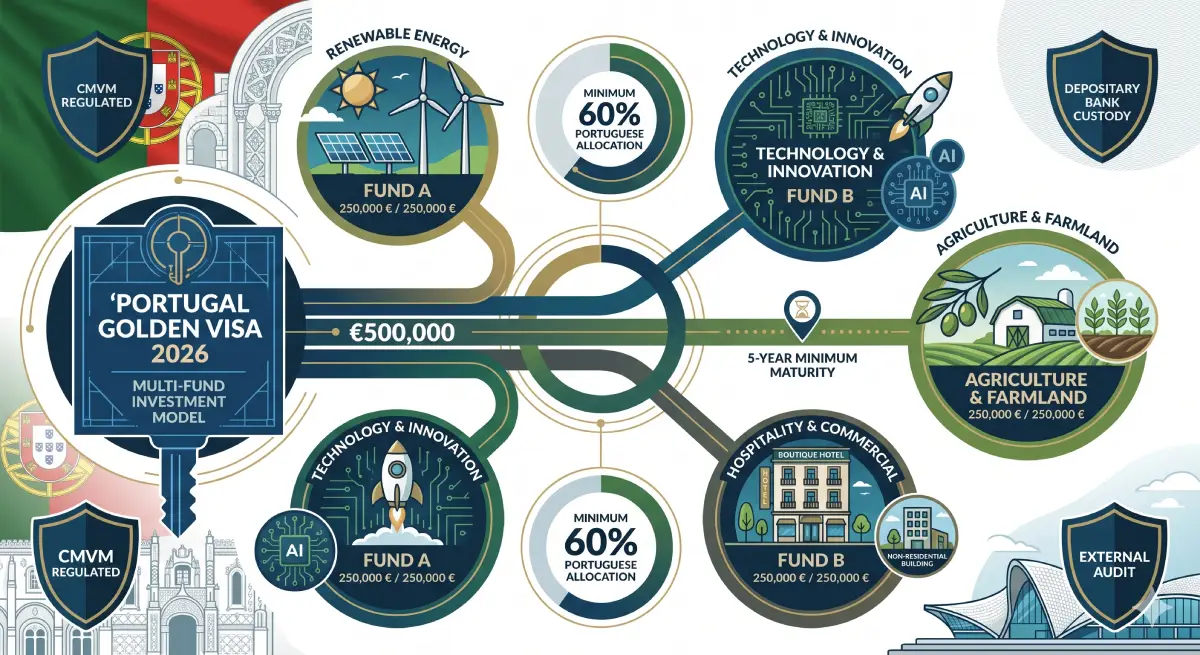
The ability to split the minimum required investment of €500,000 into two or more investment funds is the most powerful risk management tool in the current program. This flexibility allows applicants to:
- Decouple legal security from a single asset or investment thesis.
- Distribute capital across different sectors of the Portuguese economy, such as renewable energy, technology, regenerative agriculture, and educational infrastructure.
- Build a resilient portfolio capable of navigating global economic cycles while meeting the strict requirements of AIMA (Agency for Integration, Migration, and Asylum).
Market Indicators and Consolidated Data (2025-2026)
| Market Indicator | Consolidated Data |
| Minimum Investment (Funds) | €500,000.00 |
| Annual Growth of the Fund Route | 121% (since 2019) |
| Requirement for Portuguese Allocation | Minimum 60% of the fund’s capital |
| Required Maturity Term | Minimum of 5 years at the time of subscription |
| Volume of Applications (2025) | 4,990 Residence Permits granted |
The Legality and Advantages of Multi-Fund Diversification
Portuguese legislation (specifically Law No. 23/2007, as updated) does not mandate that the €500,000 investment be allocated to a single vehicle. Legal interpretation and AIMA’s administrative practice confirm that the requirement is the total amount invested in units of eligible funds.
By opting to invest in, for example, two funds of €250,000 each, the investor mitigates “management risk.” While all funds are regulated, each Management Company (SGOIC) has its own investment thesis and track record. Diversification ensures that if a specific sector faces headwinds, the global portfolio and visa eligibility remain protected by the performance of other vehicles.
Synergy Between Risk and Return Profiles
Diversification allows for the creation of a balanced portfolio that combines conservative assets with growth-oriented ones. In the current market, eligible Private Equity and Venture Capital funds can offer very different projected returns, ranging for instance, from 5% to 20% per annum:
- Capital Preservation Funds (Conservative): Focus on stable and consolidated sectors. Target returns: 3% – 5%.
- Growth and Income Funds (Moderate): Focus on Portuguese SMEs or renewable energy projects with Guaranteed Power Purchase Agreements (PPAs). Target returns: 7% – 10%.
- Venture Capital Funds (Aggressive): Focus on AI, Biotech, and Fintech startups. High upside potential, often exceeding 15% – 20% at the time of exit.
The Regulatory Ecosystem: The Four Pillars of Security
A common concern when moving away from physical assets (real estate) is the perceived loss of control. However, the security offered by funds regulated by the CMVM (Portuguese Securities Market Commission) is technically superior to individual ownership due to the segregation of duties:
- CMVM: The central regulator that approves fund regulations and supervises management companies.
- Management Company (SGOIC): The licensed entity responsible for strategic investment decisions.
- Depositary Bank / Custodian: An independent financial institution that holds the investor’s capital. It has a legal duty to ensure every capital movement complies with the law and the fund’s rules.
- External Auditor: Top-tier firms (such as the Big Four: PwC, Deloitte, EY, KPMG) that certify the fund’s accounts and valuations annually.
Sector Analysis: 2026 Investment Trends
1. Renewable Energy and Green Infrastructure
Portugal is a European leader in the energy transition. Funds in this sector invest in solar, wind, and green hydrogen, offering predictability through long-term contracts.
2. Agriculture and Farmland
The Portuguese agricultural sector has seen extreme professionalization. These funds focus on high-value crops (almonds, olives) and regenerative practices. The advantage here is the ownership of a tangible asset—land—which acts as an excellent hedge against global inflation.
3. Technology and Innovation
Lisbon and Porto have become vibrant tech hubs. Venture Capital funds capture this energy by investing in SaaS, AI, and life sciences, offering the highest potential for capital appreciation.
4. Hospitality and Commercial Assets (Non-Residential)
While residential real estate is excluded, investment in hotels and luxury resorts through funds remains highly popular. This model captures mainly operational profits and subsequent asset and business sale in Portugal’s record-breaking tourism industry environment.
Tax Efficiency for Foreign Investors
The Private Equity Fund (FCR) structure offers one of the most competitive tax architectures in Europe for non-residents:
- Dividends/Distributions: Often subject to a reduced withholding tax of only 10%, or even total exemption for non-residents (excluding those in tax havens).
- Capital Gains: Gains from the redemption of fund units are generally exempt from tax in Portugal for non-residents. This contrasts sharply with real estate, where gains can be taxed up to 28%.
- Maintenance Costs: There are no annual property taxes (IMI) or municipal fees associated with funds.
The May 2026 Citizenship Reform: Practical Implications
In May 2026, Portuguese nationality laws were updated. The general residency period for naturalization was increased from 5 to 10 years.
The Path to Permanent Residency and Citizenship
- Years 1–5: Maintain the investment and fulfill the 14-day stay requirement every two years.
- End of Year 5: Apply for Permanent Residency (PR). Once PR is granted, the investor may liquidate the investment and recover the capital while maintaining the right to live and work in Portugal.
- Citizenship: For CPLP nationals (such as Brazilians), the period is 7 years; for other nationalities, it is 10 years.
The Role of The Blue Portugal in Strategic Coordination
Managing multiple funds and navigating different depositary banks requires expert coordination. The Blue Portugal acts as the hub of this ecosystem, bridging the gap between Management Companies, Banks, Immigration Lawyers, and the Investor.
We ensure that:
- The “60% Rule” (local allocation) is verified for each fund.
- International transfers comply with banking “Know Your Customer” (KYC) requirements.
- The investor receives independent curation, avoiding conflicts of interest.
Conclusion
The Portugal Golden Visa in 2026 is a program designed for the modern investor. Through the fund route, Portugal offers more than just a “Plan B“—it provides a robust “Plan A” for global mobility and capital preservation in an ever-changing world.