
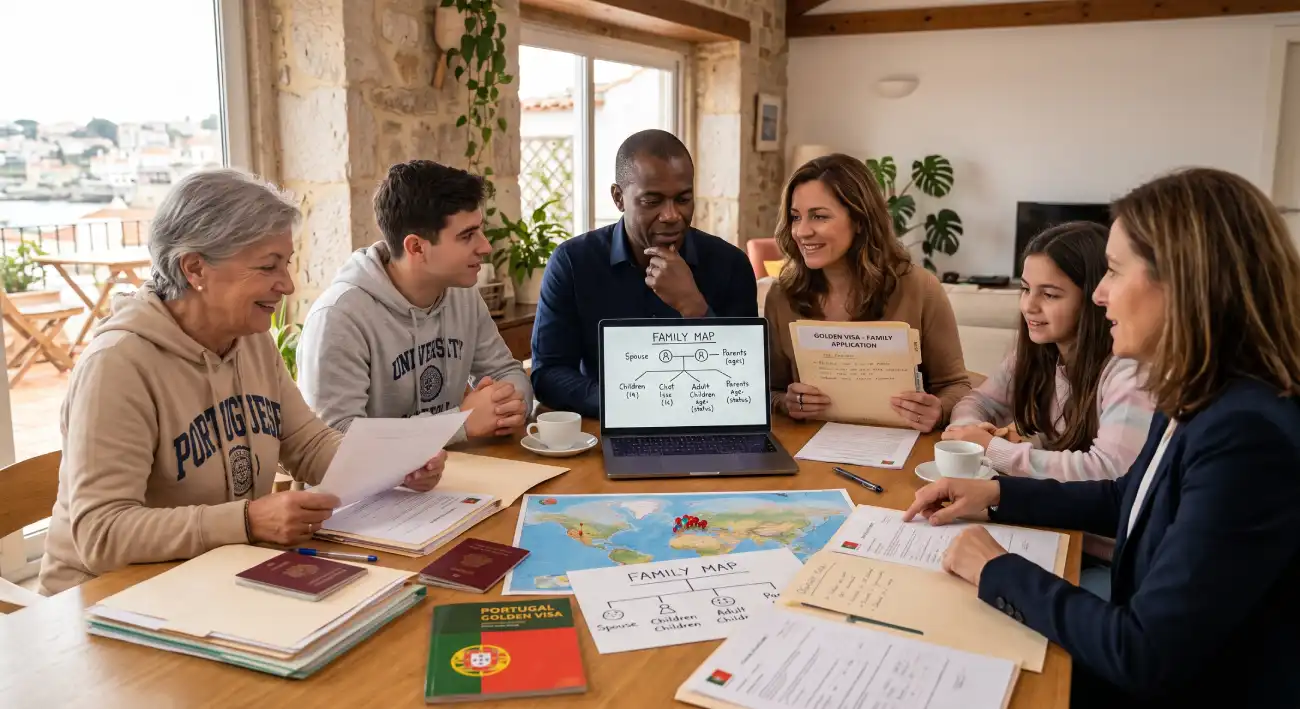
A Portugal Golden Visa application is often discussed through the lens of the main applicant.
Who is making the investment? Which investment route will be used? What documents are required? When can the application move forward?
These questions are important. But for many international families, they are only the starting point.
A Golden Visa application is rarely just an individual decision. It is often a family strategy.
The spouse, partner, children and parents may all be part of the planning. Each person can bring different documentation needs, eligibility questions and timing considerations. When this is not mapped early, a process that initially looks straightforward can become more complex than expected.
Family inclusion should not be treated as an administrative detail to solve later.
It should be designed before the file is built.
The Golden Visa is often a family decision
For many investors, the Portugal Golden Visa is not only about obtaining a residence permit for themselves.
It may be about creating optionality for a spouse or partner, giving children future access to Europe, supporting long-term education planning, including dependent parents, or building a wider family base in Portugal.
That is why the first question should not be only: “Who can be added to the application?”
A better question is: “What is the family trying to achieve with this application?”
The answer can change the strategy.
A couple planning future relocation may need a different structure from a family focused on children’s education. A main applicant with adult children may need to think differently from one with young children. A family hoping to include parents should review dependency and documentation early.
Family structure is not just background information.
It shapes the application.
Who may be included in a Portugal Golden Visa family application?
In general terms, the Portugal Golden Visa may allow the inclusion of close family members such as a spouse or partner, children, dependent adult children and dependent parents.
But each category should be understood correctly.
A spouse is not the same as an unmarried partner. A minor child is not the same as an adult child. A parent over 65 may raise different documentation questions from a younger parent who is financially dependent. A child from a previous relationship may require a different level of documentation from a child of both members of the couple.
This is why family inclusion should be mapped person by person.
The goal is not only to list relatives.
The goal is to understand who qualifies, what needs to be proven and what could affect the timeline.
Spouses and legal partners: relationship documentation should be clear
For married couples, the family inclusion analysis usually begins with the marriage certificate and supporting civil documentation.
But even in apparently simple cases, the details matter.
Where was the marriage registered?
Are the names consistent across passports and certificates?
Was either spouse previously married?
Do documents need translation, certification or apostille?
Will the spouse apply together with the main applicant or at a different stage?
For international families, these questions can be important.
A couple may have married in one country, live in another and hold citizenship from different jurisdictions. Their documentation may involve more than one legal system.
The relationship itself may be clear, but the file still needs to prove it clearly.
Unmarried partners and same-sex couples: Portugal can recognize more than marriage
One important point for international families is that Portugal may recognize unmarried partners under the concept of união de facto, or de facto union.
This can be particularly relevant for couples who are not legally married, including same-sex couples from countries where marriage equality is not available or where the relationship may not be formally recognized in the same way as in Portugal.
In Portugal, the concept of união de facto is not limited to opposite-sex couples. It can apply to two people, regardless of sex, who have lived together in conditions similar to marriage for more than two years.
This means that, in the right circumstances, the analysis should not stop at the question: “Are they legally married?”
A better question is: “Can the relationship be reliably proven under the standards accepted in Portugal?”
Evidence may include elements such as prior cohabitation, a registered partnership or union where available, shared residence history, a child in common, financial links, official declarations or other reliable proof of a stable relationship.
This matters because many international couples assume that if they are not married, the partner cannot be included.
That is not always the case.
But it also does not mean that every informal relationship will be accepted automatically.
The relationship should be reviewed carefully, especially when the couple comes from a jurisdiction where same-sex marriage, civil partnership or formal recognition of the relationship is limited or unavailable.
For these families, early guidance is essential.
The goal is to understand what can be proven before the application depends on it.
Children under 18: usually straightforward, but still document-sensitive
Minor children are often included in a family Golden Visa strategy.
For parents, this may be one of the most important reasons to consider Portugal: future education, European mobility, safety, residence optionality and long-term citizenship planning.
But even with minor children, documentation should not be treated casually.
The application may need to prove the parent-child relationship, custody or parental responsibility, especially when the child is from a previous relationship or when only one parent is included in the process.
Names, dates, birth certificates, passports and family records should be consistent.
If a minor child is legally under the responsibility of one parent, or if the other parent is not part of the application, additional documents may be required depending on the circumstances.
The younger the child, the more straightforward the planning may appear.
But the family file still needs to be coherent.
Adult children: dependency, education and marital status matter
Adult children require more careful planning.
They are not treated in the same way as minor children.
In Golden Visa family planning, adult children may be considered when they remain unmarried, financially dependent and studying. In practice, this is one of the categories where timing can matter most.
A family should review:
Is the adult child unmarried?
Are they financially dependent on the parents?
Are they studying?
Can the family prove dependency?
Can the education status be documented?
Is the timing of the application aligned with the child’s age and academic situation?
This is where delays can create complications.
A child who clearly fits the profile at the beginning of the planning process may be in a different position later if education status changes, dependency becomes harder to prove or the family waits too long to organize the file.
This does not mean families should rush.
It means they should understand the timeline before assuming that an adult child can simply be added later.
Adult children should be mapped early.
Parents: dependency and age should be reviewed before the file is built
Parents may also be part of a Portugal Golden Visa family strategy.
For many investors, this is not only a legal or administrative question. It is a family security question.
Some applicants want to create a European option not only for themselves and their children, but also for older parents who depend on them or may need a more stable long-term base.
However, parent inclusion should be reviewed carefully.
The analysis may involve age, financial dependency, family relationship, residence, available documents and whether the parent is connected to the main applicant or the spouse.
A parent over 65 may be approached differently from a parent under 65 who depends financially on the applicant. In both cases, the file should be organized in a way that clearly supports the family relationship and, where relevant, the dependency.
This is especially important for families with parents living in another country, receiving support informally or lacking simple documentation to prove dependency.
The fact that a parent is part of the family is not the only point.
The application needs to show why and how that parent fits into the family inclusion strategy.
Families are not always simple on paper
International families can be complex.
A couple may be unmarried.
A same-sex relationship may not be recognized in the country of origin.
A child may be studying abroad.
A parent may depend financially on the applicant without a formal support agreement.
A family may have documents issued in different countries and different languages.
A spouse may have changed names after marriage.
A child may be from a previous relationship.
A parent may live in a country where documents are slow to obtain.
None of these situations automatically means the family cannot be included.
But they should not be discovered late.
The earlier these realities are mapped, the easier it becomes to understand what evidence may be needed and which points require closer review.
A strong family application is not built by assuming that every relationship is obvious.
It is built by documenting the family structure clearly.
Documentation should follow the family map
One common mistake in a family Golden Visa application is collecting documents before the family map is clear.
This can create unnecessary work.
The family may collect certificates that are not immediately needed, overlook documents that are essential, or fail to notice that certain documents require translation, certification or apostille.
A stronger approach begins with structure.
Who is the main applicant?
Who should be included?
What is the relationship to each family member?
Is the relationship based on marriage, de facto union, parenthood, dependency or guardianship?
Which documents prove that relationship?
Where were those documents issued?
Do they need translation or certification?
Are there any dependency, custody or timing issues?
Does the family structure match the long-term objective?
Once these questions are answered, document collection becomes more organized.
The file starts to make sense as a whole.
Family inclusion is part of the strategy
A family Golden Visa application is not just about adding names.
It is about designing the file correctly from the beginning.
For many families, the application may connect to education, future relocation, retirement, citizenship planning, cross-border mobility, wealth preservation or long-term security.
Each of these objectives can affect how the family should think about timing and preparation.
If the goal is future citizenship, the family may need to think about long-term residence timelines.
If the goal is education, the age and study status of children may matter.
If the goal is multi-generational security, parents may need to be reviewed early.
If the goal is optionality, the family should understand who truly needs to be included from the start.
The administrative file is only one layer.
The family plan is the real context.
Build the family map before building the file
A Portugal Golden Visa application can involve many elements: investment, banking, documents, source of funds, legal review and timing.
When family members are included, the process gains another layer of detail.
That detail is manageable when it is mapped early. It becomes harder when it is discovered late.
Before requesting documents or preparing the file, families should understand who enters the application and why. Spouses, legal partners, unmarried partners, same-sex partners, children, adult children and parents may each require different attention.
This can seem like a lot to organize.
And in many cases, it is.
But that is exactly why family inclusion should be treated as a strategy, not as a checklist.
The objective is not simply to add relatives to an application.
It is to build a file that reflects the real family structure, supports the long-term plan and anticipates the questions that may appear along the way.
A stronger application begins with a clearer family map.
Map the family before building the file.